Tangents
This is a home for side paths, sketches, thinking, explorations, and older studies. Nothing here is meant to be finished, bug-free, or purpose-driven — just open-ended tinkering to follow a hunch or understand how something works.
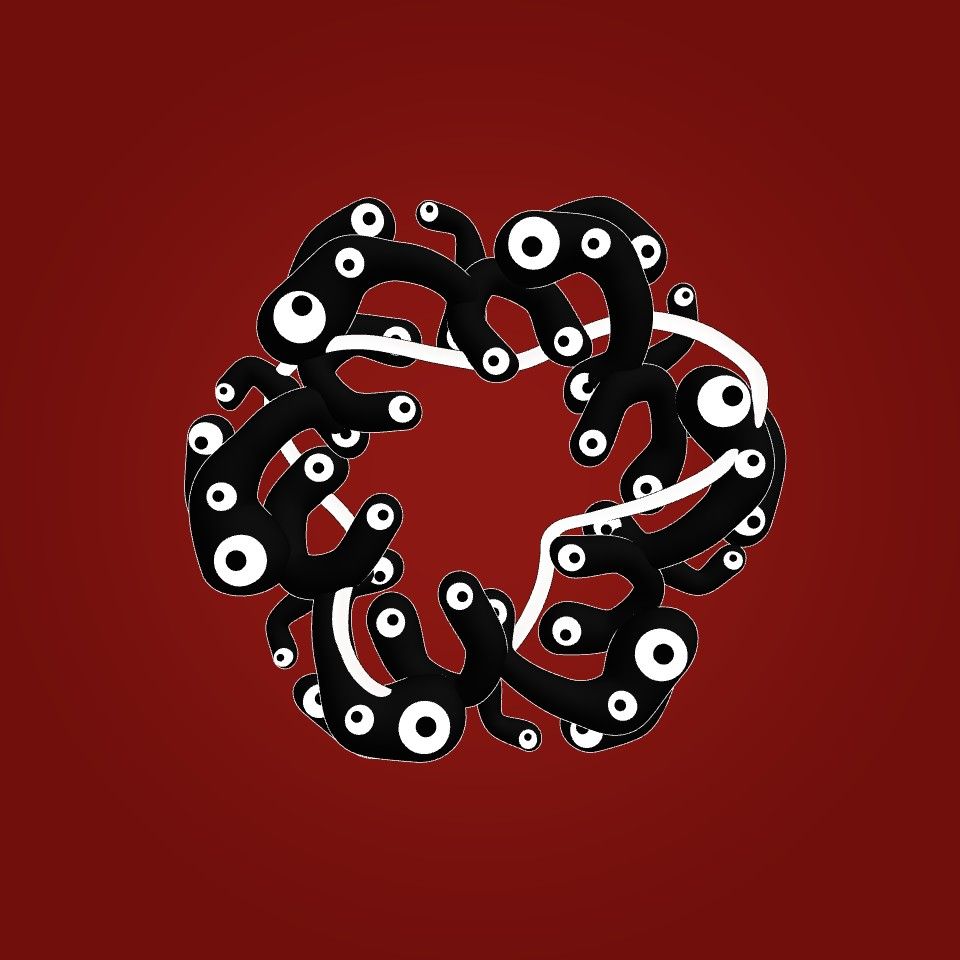
Listening to a Drawing Blink
A small toy built with Google's Carbon model to see what it could extrapolate from a single image of an earlier Fragments drawing and a bit of prompting. It also explores an ongoing interest in self-playing musical forms: once clicked, the sculpture breathes, follows the cursor, and plucks a spatialized tone each time one of its eyes blinks.
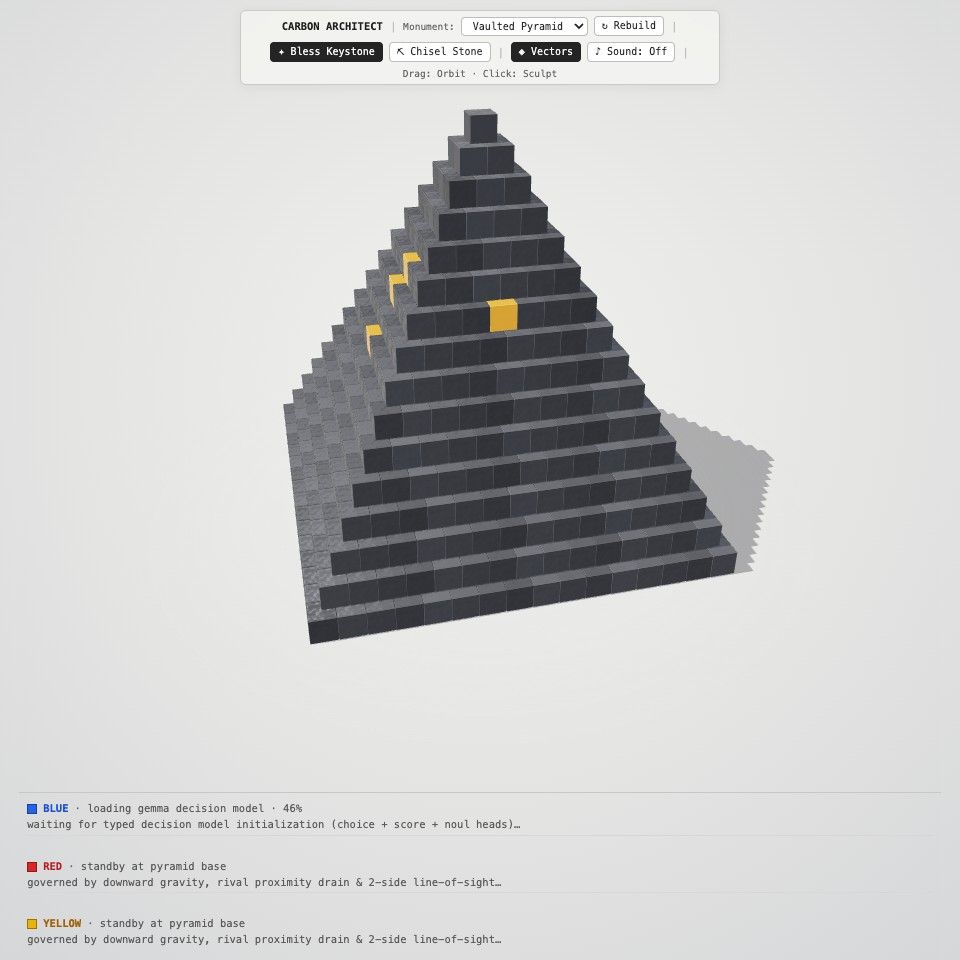
Rethinking the Shortest Path
An experiment in running a small Gemma decision model directly in browser memory — revisiting an earlier interest in A* pathfinding without a fixed heuristic. Three competing climbers weigh gravity, line of sight, rival proximity, and blessed keystones in real time while you chisel and rebuild the steps beneath them.

Chasing What the Hand Draws
A 2017 WebGL study in coaxing shader math toward the tangled, organic density of hand-drawn ink. Expanding the Gray-Scott reaction-diffusion loop to a thirteen-point Laplacian stencil and passing the output through cubic color curves keeps crimson, black, and bone-white channels churning inside a circular frame.

Seeding the Loop by Hand
A 2017 study pairing hand-built spiral seed textures with a modified Gray-Scott reaction-diffusion shader. Rather than starting from random noise, the painted spiral guides where continuous bands hold together and where the inner core breaks apart into individual cells.

Searching for Softness in the Grid
A 2017 reaction-diffusion study focused on softening the underlying pixel grid. Layering quintic texture interpolation over zoned Gray-Scott parameters confines growth to a central cluster of smooth, branching crimson channels.

Keeping the Reaction Alive
In Gray-Scott reaction-diffusion, most parameter combinations quickly evaporate to white or flood solid black. This 2017 study maps slightly different feed and kill rates across hidden color regions to hold an active ring of spots and stripes in balance around an open center.